AC3 Merges with CAFA

Image of the US Capitol building taken facing eastward from the base of Capitol Hill across the reflecting pond in autumn. Text: Climate Action For Associations

I’m excited to share that I’ve stepped into a new volunteer role as US Co-Lead (with the fabulous Maddie Grant) for Climate Action For Associations. CAFA America will subsume our existing climate change project, the Association Climate Action Coalition (AC3).

(Don’t worry – I’m still Chief Strategist at Spark, providing membership and lean startup methodology consulting to associations. This is a new volunteer role for Maddie and me.)

CAFA is a global initiative helping associations turn climate commitments into practical, coordinated action.

Our focus will be on supporting the launch and growth of CAFA’s work in the United States—building partnerships, piloting programs, and helping shape an operating model that reflects the realities of the American association landscape.

Associations play a unique role in shaping industries, professions, and collective standards. When we move together, we have the power to accelerate real change at scale. I’m grateful to be working alongside CAFA’s global team and a growing network of association leaders who are serious about moving from intention to impact.

Through this partnership, AC3 members will now have access to CAFA’s global hub, including resources, tools, and guidance. Membership is free, and is now open to ALL US associations.

Are you ready to join right away? Visit the CAFA website to learn how

Lean at 10: The Podcast, Part 4

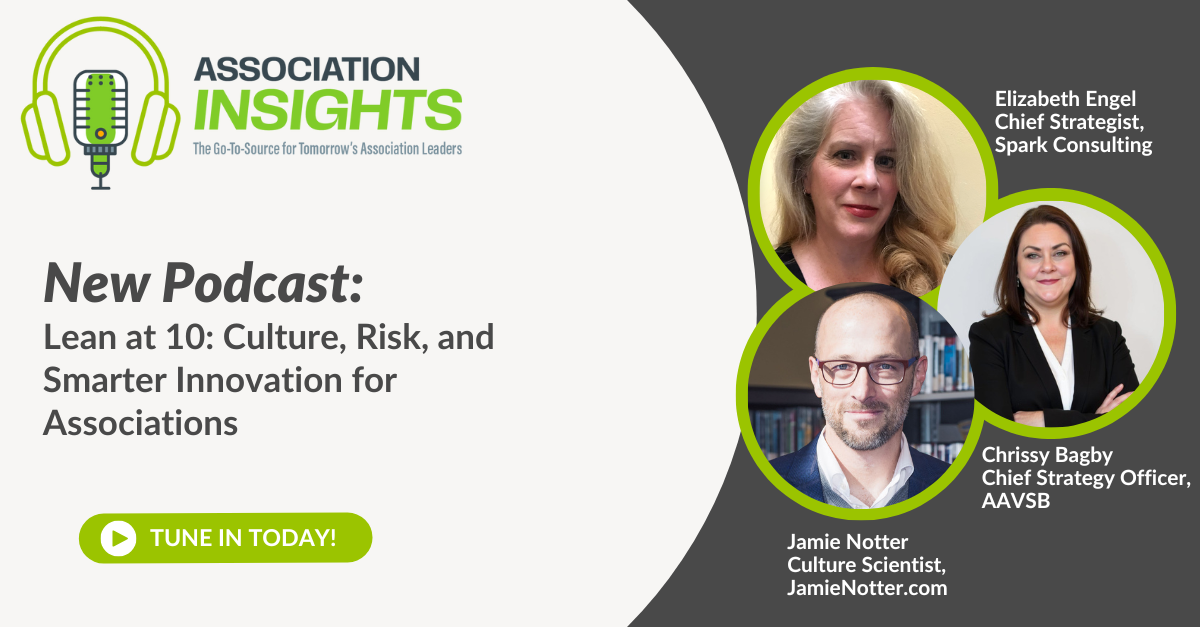
Header graphic in shades of lime green, white, and grey with three full-color headshots on a grey background the right side: two white women and one white man with glasses. Text: Elizabeth Engel, Chief Strategist, Spark Consulting, Chrissy Bagby, Chief Strategy Officer, AAVSB. Jamie Notter, Culture Scientist, JamieNotter.com. Text on the left side includes a logo that is lime-green headphones around an old-school microphone and reads: Association Insights: The Go-To Source for Tomorrow's Association Leaders. New Podcast: Culture, Risk, and Smarter Innovation for Associations. At the bottom is a lime green bar with the text Tune In Today!

Jamie Notter, Chrissy Bagby, and I recently had the opportunity to have a candid conversation about what it really takes to innovate with the Association Insights Podcast host Colleen Gallagher.

Based on our recent whitepaper, Lean at 10: Culture Eats Methodology for Lunch, we discussed how lean startup methodology, paired with an intentional approach to culture change, can help associations escape the “we have always done it that way” trap.

The episode focuses heavily on the American Association of Veterinary State Boards case study, where Chrissy shares how her team moved from big, risky projects built on a foundation of unarticulated and untested assumptions to structured experiments buoyed by shared understanding and the role of the “cooperative skeptic.”

Tune in for honest, practical insight into bringing lean startup into your association, whether you’re a C-suite executive or leading from the middle:


A Decade of Lean Startup: Lessons Learned

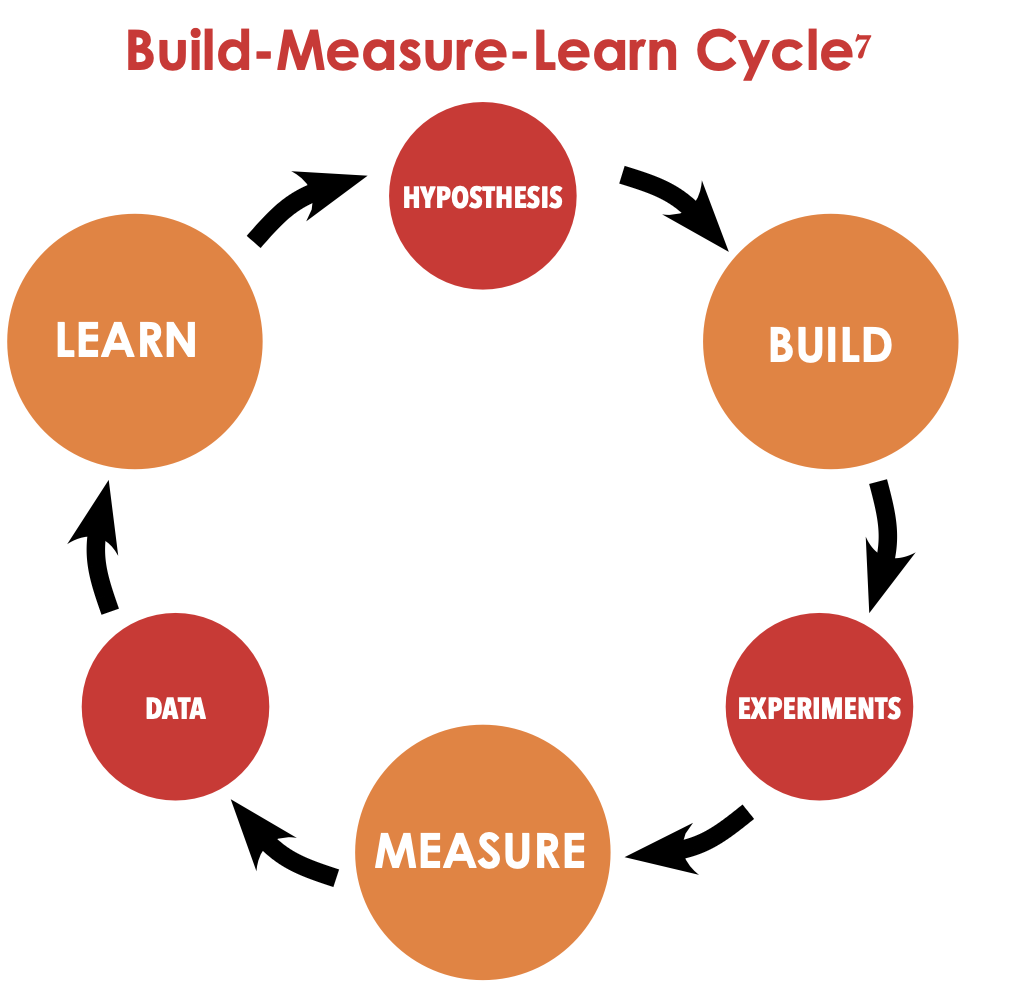
Build-Measure-Learn cycle. Orange circle that reads Build with arrow to red circle that read Experiments with arrow to orange circle that reads Measure with arrow to red circle that reads Data with arrow to orange circle that reads Learn with arrow to red circle that reads Hypotheses with arrow back to original Build orange circle

Association execs are always on the lookout for good ideas for new programs, products, and services, and once we think we have one, we want to build it as quickly and efficiently as possible. What are the challenges associations face in developing their ideas? How can lean startup methodology help? What is the role of organizational culture in successful innovation?

Spoiler alert: After ten years of working with lean startup methodology one of the main things we’ve learned is that it’s not the concepts, tools, and techniques that are the hard part – it’s the culture change.

Join me, Jamie Notter, Chrissy Bagby, and Tiffany Dyar on Wednesday, November 5 for a FREE webinar, A Decade of Lean Startup: Lessons Learned, to learn about the challenges presented by the culture change necessary to use lean startup successfully and gain the tools you need to address those challenges in your own organization.

Details and RSVP here.

Lean at 10: The Podcast

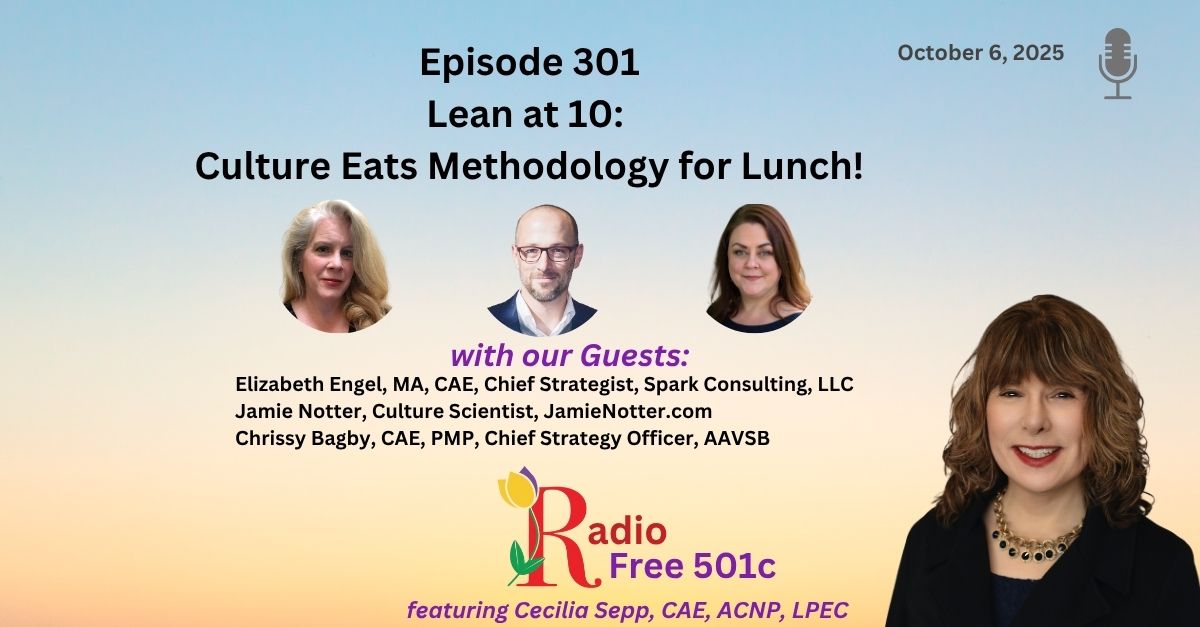
Podcast header card that includes photos of four people (all white, three women and one man - the podcast host and three guests). Text includes: Radio Free 501c with your host Cecilia Sepp, Episode 301, October 6, 2025 - Lean at 10: Culture Eats Methodology for Lunch. With our guests Elizabeth Weaver Engel, Jamie Notter, and Chrissy Bagby"

Jamie Notter, Chrissy Bagby, and I were honored to join Cecilia Sepp recently on Radio Free 501c to discuss our latest whitepaper, Lean at 10: Culture Eats Methodology for Lunch.

On the pod, Jamie and I outlined some of  the major concepts we cover in the paper. We also discussed why we chose to revisit this topic 10 years after the publication of the original Innovate the Lean Way monograph I wrote with Guillermo Ortiz de Zárate. Then Chrissy detailed how she and her colleagues at the American Association of Veterinary State Boards apply lean startup methodology principles to test ideas for new programs, products, and services. One of her key pieces of advice: “Challenge your idea of failure.”

Listen or view at: https://www.youtube.com/watch?v=E7031J-UI60

Lean at 10: Culture Eats Methodology for Lunch

Ten years ago, Guillermo Ortiz de Zárate and I co-authored Innovate the Lean Way, a free monograph designed to introduce lean startup methodology to the association industry, explain why we think it’s a good fit for us, and share some stories of associations using it successfully to test out and develop their ideas for non-dues revenue programs, products, and services.

Last fall, with the paper’s 10 year anniversary approaching, G and I thought it might be fun to revisit the topic, this time with a focus on what we’ve learned in the past decade of working with concepts, tools, and techniques of lean startup (which we still think is a very useful tool to assist associations’ non-dues revenue efforts).

That new monograph, Lean at 10: Culture Eats Methodology for Lunch, is ready and available for download at https://bit.ly/LeanAt10.

As you might guess from the title of this post, one of the main things we’ve learned (spoiler alert) is that it’s not the concepts, tools, and techniques that are the hard part – with a little time and effort, your team can learn them and become proficient. The hard part is the culture change, which explains why, in this iteration, we worked with Jamie Notter, who you may know for his excellent work on culture and culture change, to explore what you need to know and do to create a culture that will support and encourage innovation as a practice, enable you to take effective action, provide organizational clarity, and develop the courage to engage difficult conversations.

The whitepaper also includes:

  • Case studies with the American Association of Veterinary State Boards, the National Council of Architectural Registration Boards, and the National Registry of Emergency Medical Technicians.
  • A sidebar of lean startup methodology tools.
  • A series of thought questions for you to use to spark discussion with your team.
  • An extensive list of resources in case you want to dig deeper on any of the topics addressed.

As is always the case with the Spark collaborative whitepapers, it’s 100% free, and you don’t even have to provide any information to download it – you can just have it, no landing on a mailing list you didn’t ask for or having to dodge calls from us.

Are You Lean-Curious?

Small brown and white owl perched on a branch in the woods with a quizzical expression on their face

By this point, most executives have probably at least heard of lean startup methodology. You may even know that it’s used for product development, and, in the association context, particularly applicable to ideas for new non-dues revenue programs, products, or services. Perhaps you’ve heard of the Build-Measure-Learn cycle, or the idea of the Minimum Viable Product. Maybe someone has mentioned vanity metrics versus Metrics That Matter (and you can hear that capitalization in their voice) to you.

  • But what, really, is lean startup methodology?
  • Where did it come from?
  • What do all those terms mean?
  • How does the methodology work?
  • What tools exist to support the methodology?
  • How does it apply to associations?
  • Are any associations using it successfully?

Answers to all these questions and more can be found in Innovate the Lean Way, a monograph I co-authored with Guillermo Ortiz de Zárate (of NCARB at the time, now of the American Society of Appraisers) ten years ago. Yes, it’s still relevant, and G and I think that associations would still benefit from learning how to ensure they’re heading the right direction as they think about an audience of customers or members, the problem they’re trying to solve for that audience, and their potential solution to that “problem worth solving.”

Are you read to dive even deeper? Check out my new Lean Startup Series of services.

Regular blog readers may also notice that I’ve been revisiting lean startup concepts pretty regularly over the past several weeks. There’s a reason for that, which will be revealed next week. (Can’t wait that long? Click here.)

Photo by Dominik Van Opdenbosch on Unsplash

Retooling Your Business Model

electric car charger plugged into a silver car

Earlier this week, Associations Now profiled a recent report from McKinley Advisors, Business Model Innovation, in which they identify five innovation elements that can provide the revenue that fuels your association’s ability to achieve your mission:

  1. Value – rethink your value proposition
  2. Revenue – pursue new pricing strategies
  3. Community – provide opportunities for relationship-building, both online and in-person
  4. Reach – expand your thinking beyond just your members
  5. Operations – get your own house in order to support all this

These are all good points.

But how do you actually do those things?

One possibility: lean startup methodology.

Lean startup allows you to jump start your innovation practice and non-dues revenue via a structured process that can help you to learn whether you’ve identified the right audience, whether you’ve selected a problem that’s both real and significant for them, and whether your audience is willing to use – and pay for – your great idea to solve their problem.

Remember: It doesn’t matter how quickly you’re moving if you’re headed in the wrong direction.

Learn how Spark can help.

Photo by CHUTTERSNAP on Unsplash


Reaching Detente With Your Chapters

pink and white boxing gloves on a grey concrete background

One of the truisms of association management is that national/chapter relationships are often…fraught. Even though we’re all ostensibly on the same side, it doesn’t always feel that way. Each side feels like the other is holding out on the them or trying to gain advantage, and the lack of trust that results makes it hard to communicate and to work together for the good of the organization as a whole and, ultimately, the profession or industry you serve.

How do you get past this?

I was recently chatting with some colleagues who were working through this exact problem. Details concealed, of course, but a little background. The organization has chapters in every state. As is common, some are quite strong and many are less so. The national provides staff support for chapters, but it’s in the form of two staff members who are both in DC (and in the eastern time zone).

The national wants to switch to an “account executive” model, dividing the country into regions and locating a regional chapter support manager in each of them. Those regional managers would still report to the national membership director, but they would work remotely and be charged solely with supporting the chapters in their region (so they would really work FOR the chapters).

Sounds great, right? Unless you’re a strong chapter that’s worried that this is a power grab by the national. And there is one chapter in particular with a strong, nationally-known executive and a full staff of their own. The national staff is concerned that she will lead the revolt that will doom their plan to help struggling chapters by providing better overall support and coordination.

What we realized is that this apparent negative could actually be a huge advantage. But it would all depend on the approach. Going to the strong chapter executive with, “This is the plan that we, the national, in our great and mighty wisdom, have devised for you, the poor little chapters, and you’ll accept it whether you want to or not!” would result in disaster. It turns her into an opponent immediately. “My chapter is just fine, and we don’t need your help/interference, thanks.”

But, if the national approached the strong chapter executive with this as a POSSIBLE idea to provide better support for the chapters that they’d very much like her to PILOT for them before they consider rolling it out to all the chapters, suddenly, we’re on the same side of the table working together to solve a problem.

Of course, the national has to be genuine. The program really IS a pilot and is open to modification – or even being dumped – based on the experiences of the beta group, which should probably consist of some chapters of all types, strong and weak. The staff person would remain at the national headquarters during the pilot, but she would switch her work schedule to better align with the region’s time zone. And if the beta testers came up with a better idea, the national would pilot that as well.

How can you start standing next to your chapters facing issues together rather than standing opposite them and *being* the issue?

Photo by Arisa Chattasa on Unsplash
Is a Consultant Right for Me?

Woman with short dark hair, glasses, and red lipstick wearing a black and red flower pattern blouse standing against a brown carved wooden door and making a quizzical face

You know you need help with something, but you’re not sure if you should hire a consultant, a contractor, a vendor, or add a staff position. How can you decide?

I recently had the opportunity to participate in a discussion about this with association colleagues representing all those background and options.

We did come up with some good questions to help you figure it out:

  • Do you want someone who can be “brutally honest” in telling truth to power?
  • Do you need this skill set every day forever or do you just need it for now?
  • Do you need this skill set full time or part time?
  • What will the IRS think about the way this person is classified?

Working in reverse order:

IRS

The IRS will be displeased if you try to classify someone as 1099 if they really work for you. There are a variety of tests the person has to pass – here’s a good summary – but an easy test is: Does this person have or actively seek other clients?

FT v PT

Plenty of small associations don’t need a full time dedicated staff person for things like IT support, HR, finance, even maybe running your conference or membership renewals. Those are all good candidates for outsourcing, to a contractor, vendor, or even an AMC (association management company).

Forever v For Now

You may not need active guidance on strategic direction every single day. You do need implementation of your strategic direction every single day. Setting your strategy may be a good place to engage a consultant, not least of which because we have the advantage of perspective – we’ve seen a LOT of associations representing a LOT of different professions and industries. Executing your strategy requires staff, and it requires those staff members to understand not only where you are and want to go, but why.

“Brutally honest”

Boards of directors are sometimes suspicious of consultants. “Why are we paying this person all this money for something we could’ve done ourselves?”

Well, one, you didn’t do it yourself, which is why you need me to do it for you.

Being a bit less flip, sure, association staff or volunteers could compile and review data and documents, talk to members and other audiences, benchmark against other associations, and do sector and trend research. But do any of them actually have the time to do that? Staff members have, you know, their day-to-day JOBS, and so do volunteer leaders.

But in a larger sense, while it is OFTEN the case that staff members tacitly know what needs to happen, consultants can explain WHY it needs to happen by doing all that data work and research, and because of our knowledge of and exposure to lots of different organizations. Ideally, the consultant is a compliment to the staff on knowledge, insight, and even execution.

As one of my fellow consultant participants in the conversation put it: “I’m not here to replace your job. I want coach and train staff into implementing my recommendations, which is the thing that will actually make the difference, not the report itself.”

Photo by Paola Aguilar on Unsplash

Can I Trust You?

Two women in a field holding hands and leaning back away from each other, trusting that the other woman will hold her up

I was recently thinking about something my very smart friend Jamie Notter is fond of saying: Trust and risk are correlated. As trust goes up, risk goes up. In order to lower risk, we also end up lowering trust.

Ever wondered why staff members have such strong reactions to new policies at your association? Voilà. That reads, on some level, like you don’t trust them.

Here’s the thing: we can’t just throw out all our policies and skip merrily along trusting everyone completely and all the time. First of all, my many lawyer friends would be out of business if we did.

But also, it’s not realistic. There are people out there who, through ignorance, accident or ill intent, can harm our associations. Our members and the other communities we serve have the right to expect us to do what we can to protect our associations, by preventing what risks we can and being prepared to ameliorate those we can’t.

On the other hand, our staff members deserve respect and professional courtesy. After all, if we can’t trust them even a little bit, why did we hire them in the first place?

I don’t have the perfect answer to this. In fact, there isn’t one. Different organizations have different levels of tolerance for and exposure to risk. If you deal with HIPAA protected data, you know exactly what I mean.

I think this raises and important consideration for us as part of our own risk calculations. We often focus on the downsides of being more open, more trusting, etc in assessing risk. Do we think about the other side: What is the risk of reducing trust?

Photo by Julia Caesar on Unsplash