A question has been popping up in the association community with increasing frequency: “Is AI going to kill our online community?”
This is a scary proposition, because whether it’s an owned platform like Higher Logic or Breezio or a public platform like Meta or LinkedIn, associations have poured resources into online communities in the past decade.
The concern is that members will just go to Google, type in their question in natural language, and accept whatever the Answer Engine (aka the AI summary that now tops search results) returns as authoritative. Is it as good as they could’ve gotten by logging into your online community and posing the question there (or, while we’re at it, visiting your website)? Maybe not, but they also didn’t have to do all that other stuff, and maybe the AI response is “good enough.”
So yes, it’s possible AI will cause your online community to wither, or to devolve into primarily an announcement board, particularly if there’s no authentic sense of belonging, something that is much harder to generate in a professional community than in something personal-interest driven.
But there’s also an opportunity to evolve your online community into a true Community of Practice. First introduced by Etienne Wegner about 35 years ago:
“Communities of practice are groups of people who share a concern or a passion for something they do and learn how to do it better as they interact regularly.”
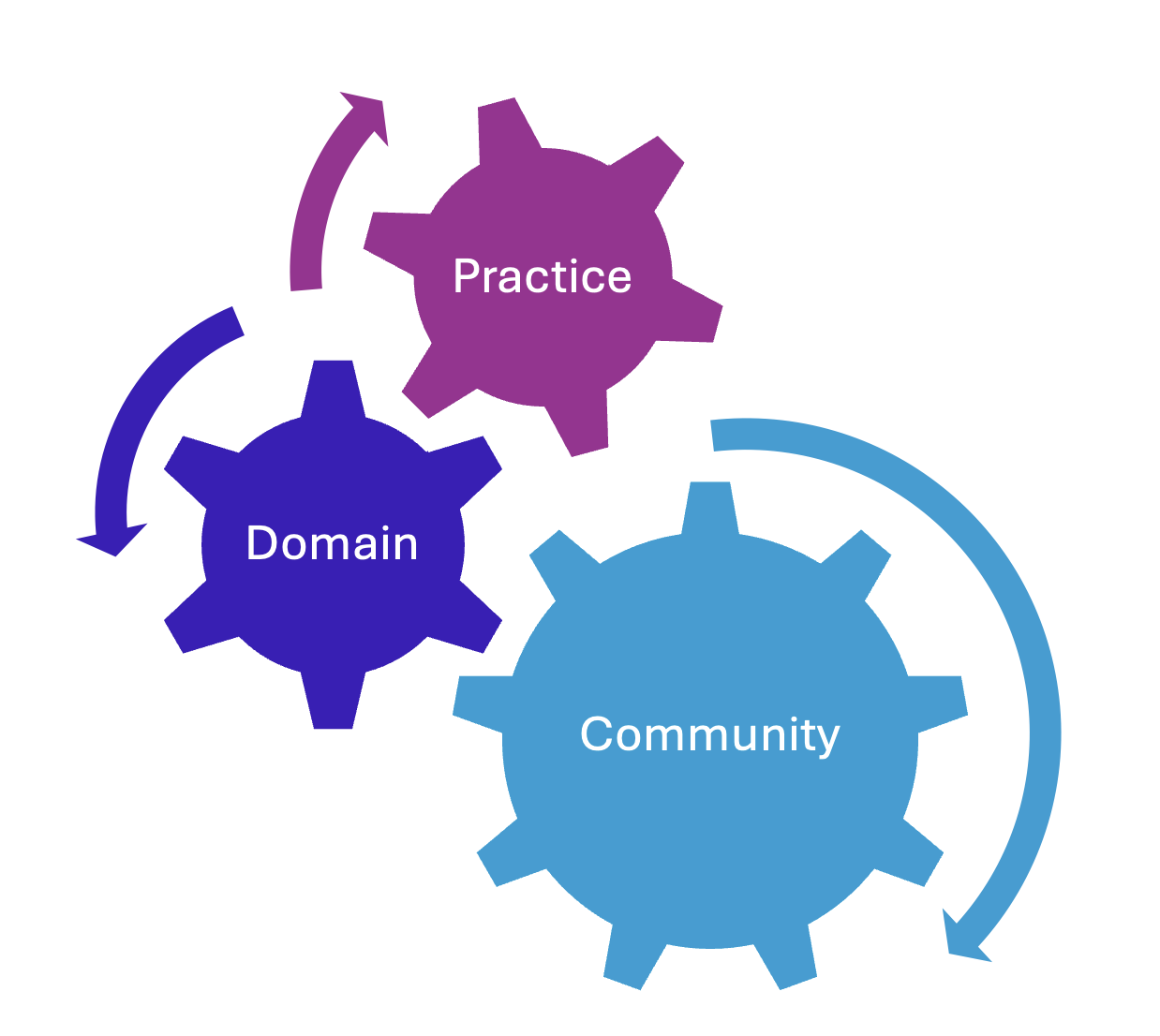
They’re comprised of the Domain (the topic, interest, or project that has brought the group together, with an implied level of shared expertise), the Practice (the actual work and what the group creates as a result of that work), and the Community (the people who are working together, building relationships and helping each other along the way).
As Anna Caraveli and I pointed out in our 2015 monograph, Leading Engagement from the Outside In: Become an Indispensable Partner in Your Members’ Success:
These types of knowledge-creation networks have a built-in advantage. While products have short shelf lives and can be duplicated by competitors [including AI], the value of a CoP lies in the network itself. Through their participation, CoP members can accomplish important goals together they could not otherwise have done alone. (emphasis added)
So what about AI?
Used properly, via technologies like Retrieval-Augmented Generation and small language models, AI may actually help you turn your announcement board online community into a genuine Community of Practice. AI can take over answering those same 10 or 20 questions that get asked repeatedly, and allow associations focus to our efforts not on trying to reduce human interactions (after all, people join associations because they wish to associate), but on making them better, deeper, and more meaningful.