What Do YOU See?

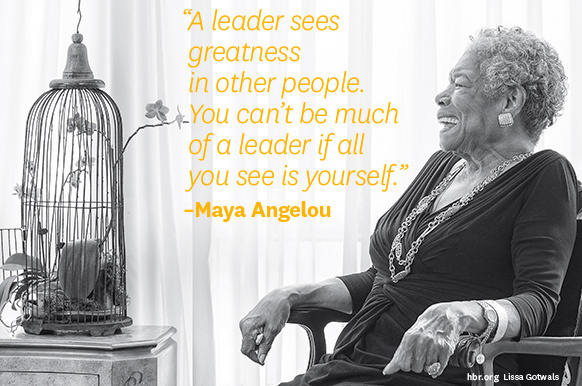
About a year ago, the Harvard Business Review did an interview with Maya Angelou. I definitely recommend checking out the entire thing, but there was one thing in particular she said that stuck with me:

Maya Angelou leadership quoteOne of the great dangers of leadership, I think, is the tendency to believe your own hype. If you achieved this great, high, responsible position, it must be because you’re that much better than everyone else, right? You earned it, all by your awesome self!

The thing is, no one exists in a vacuum. You are the sum certainly of the abilities you drew in the natural lottery and how you’ve been able to develop them but also of all the people who’ve helped you and influenced you and taught you and mentored you and led you and followed you and worked with you to achieve bigger goals than any one person could accomplish alone along the way.

And I think that’s what Dr. Angelou’s quote is about. True greatness isn’t running around singing “I AM SO GREAT! I AM SO GREAT!” It’s saying “YOU are so great.” It’s highlighting how others’ ideas helped you. It’s sharing credit. It’s talking about everyone’s contributions at least as much, if not more than, your own. It’s knowing that what you’ve achieved has been the result of many, many people’s efforts and making sure OTHER people know you know that, too.

How many of us, as leaders, are strong and confident enough to do this? How would our world be different if we did?

Image credit: Daily Good

It’s Not Magic!

I’m in St. Paul today presenting for the Midwest Society of Association Executives’ annual meeting today. Two of my sessions are on familiar topics: The Mission Driven Volunteer and my Carpe Annum IGNITE session. But one’s new: Your Membership Dilemmas SOLVED!

In it, I plan to share the great secret of consulting.

Of course, not everyone can be in St. Paul today, and I don’t want to exclude people unfairly, so I’m going to share the magic trick here, too.

Are you ready?

  1. Ask better questions
  2. Hold out for more alternatives as answers

That really is it. I mean, consultants also bring (hopefully) experience in the field (in my case, associations) and in particular disciplines in that field (membership and marketing for me) and the breadth of knowledge and experience that comes from working with a bunch of different types of organizations and keeping up on the latest research and trends.

But I truly think that what helps us help you is that we focus on asking better questions (one of THE keys to making good decisions) and that we don’t let you settle for the first, most obvious answer – we make you keep digging.

That’s really it.

So now you don’t ever need to hire someone like me again!

Ok, not really (I hope). But if you can build the capacity to think in those terms – ask better questions and push for more hypotheses – you can definitely increase your success with solving problems in-house.

Data, Experience and the Scientific Method

From the new Spark whitepaper, Getting to the “Good Stuff”: Evidence-Based Decision Making for Associations, written with Peter Houstle:

So once you’ve got the data, are you all set?

Nope.

Data is a necessary component of making smart, evidence-based decisions, but it is not the only component. Data needs to be supplemented by experience. In fact, neither experience nor data can exist successfully on its own. They come together through the scientific method. Don’t worry – we’re not advocating that you go back to school and earn a graduate degree in physics. We are, however, advocating that you think a little like a scientist.

To learn more about how data and experience can combine to help you make better, faster decisions, download your free copy of the whitepaper at http://bit.ly/1jwXcDX.

Getting Ready to Use Data

From the new Spark whitepaper, Getting to the “Good Stuff”: Evidence-Based Decision Making for Associations, written with Peter Houstle:

What are the things you need to do to get ready to use your data?

  • Address your data quality issues.
  • Measure what matters, not just what’s easy to measure.
  • Find your internal data sources.
  • Consider external data sources you might want to add.
  • Choose a tool to help you visualize your data.

Want to learn more about each of these? Download your free copy at http://bit.ly/1jwXcDX.

Big Data = Big Opportunity

From the new Spark whitepaper, Getting to the “Good Stuff”: Evidence-Based Decision Making for Associations, written with Peter Houstle:

Ultimately, Big Data supports innovation and allows us to do predictive marketing.

Why is that? With Big Data:

  • More data is easily available to relevant stakeholders
  • Accurate data helps you experiment in an organized way
  • Detailed data allows you to segment and target offers appropriately
  • Continuous data about the performance of your existing offerings provides insight so you can create new and better offerings

Want more? Download your free copy at http://bit.ly/1jwXcDX.

Evidence-Based Decision Making for Associations

I’m excited to share the launch of the fifth whitepaper in the ongoing Spark whitepaper series, Getting to the “Good Stuff”: Evidence-Based Decision Making for Associations

Co-authored with Peter Houstle (Mariner Management), the whitepaper tackles the question: how can associations use data to start asking meaningful, mission-driven questions and to inform our decision-making processes around them?

Big Data presents a tremendous opportunity for associations, but in order to realize its potential, there are some things you need to know and do. First, your data needs to be reasonably clean and complete. Then you need to look for patterns, and data visualization tools can help with that. Then you need think about the questions those patterns raise and create hypotheses to answer those questions. Then you test your hypotheses, hopefully find strong correlation (since proving cause and effect is rare), and make decisions accordingly. In the course of our research, we did discover a secret sauce to decision making success, but I’ll share more about that later this week.

Speaking of, I’ll be blogging about the contents of the whitepaper all week, but in the meantime, pick up your free copy at http://bit.ly/1jwXcDX, no divulging of information about yourself required.

Don’t forget to check out the other FREE Spark whitepapers, too:

Strategy, Risk, and Implementation

Final day of whitepaper release week!

From the new Spark whitepaper, Risk: The Missing Link Connecting Strategy to Implementation, co-authored with Jamie Notter (JamieNotter.com) and Leslie White (Croydon Consulting):

Having…conversations around risk and opportunity is not necessarily easy, but it’s becoming increasingly important in today’s complex, mutable, fast-paced environment. You need people at all levels of your association who can analyze and make key decisions that are in line with your strategic direction, and that means they need the skills and tools to quickly get beneath the surface conclusions that create conflicts in order to resolve them, decide, and act.

You do that by:

  • Asking better questions
  • Bringing assumptions to the surface
  • Agreeing to disagree
  • Focusing on the decision

You can find out more about how to do that by downloading the free whitepaper at http://bit.ly/MJ5oo8.

Additionally, Jamie, Leslie, and I offer training for senior teams to help you develop the skills to make better decisions faster. You can find out more on the Spark Services | Training page.


Risk, Strategy, Conflict, and Consensus

Whitepaper release week continues!

From the new Spark whitepaper, Risk: The Missing Link Connecting Strategy to Implementation, co-authored with Jamie Notter (JamieNotter.com) and Leslie White (Croydon Consulting):

Strategy and risk are about choosing to do certain things and, sometimes more importantly, not to do certain things. Conversations about these choices are difficult because your organization naturally has a range of overlapping concerns and interests, typically represented by specific groups of people, maybe a department or a membership segment. When you have different groups representing different interests, it often leads to conflict. And most organizations don’t handle their conflict well.

Get the full whitepaper (for free, no personal information required) at http://bit.ly/MJ5oo8.

How Does Risk Relate to Strategy?

From the new Spark whitepaper, Risk: The Missing Link Connecting Strategy to Implementation, co-authored with Jamie Notter (JamieNotter.com) and Leslie White (Croydon Consulting):

Risk management is an intrinsic part of strategic thinking. When considering a strategy, you must first determine whether that strategy aligns with your risk appetite…The biggest challenge associations face in establishing a culture of strategic risk management is to get people comfortable thinking and talking about what could go wrong—or right—on the way to realizing your excellent new ideas. The key is to match your risk exposure to your risk appetite, while not undervaluing potential lost opportunity.

Like what you read? Want more? Download your free copy at http://bit.ly/MJ5oo8.

Why Does Risk Matter?

From the new Spark whitepaper, Risk: The Missing Link Connecting Strategy to Implementation, written with Jamie Notter and Leslie White:

The risk management process involves the continuous identification, assessment, prioritization, and selection of risk management techniques; implementation; and monitoring of outcomes.

But what if the board and senior team members don’t all agree on what the risk is, how likely it is, or what impact it might have? What if the decision-makers don’t have the same appetite for risk? What if they don’t accord the potential opportunity the same level of importance? Risk management sounds straightforward in theory, but the effective practice of risk management requires broadening your awareness about uncertainty and risk and integrating this risk awareness directly into your strategic decision- making. You need to define your risk strategy.

Want more? Download your free copy at http://bit.ly/MJ5oo8.