
Making Non-Dues Revenue Work For You

Black ceramic piggy bank sitting on a pile of coins of different currencies against a white background with a white person's hand putting a coin into the piggy bank

I recently participated in a virtual roundtable on non-dues revenue.

A few things that WEREN’T working:

  • Launching a product based on the HIPO (highest influence person’s opinion, aka “the board thinks this is a great idea”)
  • Launching a product that solves a problem without first testing whether it’s a problem worth solving (the problem in questions was a real problem for the target audience, but it wasn’t a significant problem – it wasn’t one of their top priorities)
  • Launching a product based on untested assumptions (aka, no plan or due diligence, so a radical underestimation of the cost of the idea and overestimation of the likely revenue generated)

Unsurprisingly, all of those products failed.

A few things that WERE working:

  • Staying alert to emerging trends in the profession or industry the association serves (so you can spot needs for things like training in emerging topics or sub-fields and micro-credentialing)
  • Pivoting rather than killing a functioning but dusty program (participation in a program that was a major source of revenue was dropping off, and the association thought they might need to kill it, but they ultimately realized they just needed to shift the focus a bit)
  • Thinking through ALL your revenue “wells” (association execs tend to focus on members and suppliers / corporate supporters, but are there opportunities related to customer audiences as well?)
  • Considering ways you could repackage or repurpose programs, products, or services you already offer for different audiences (“create once – use many”)
  • Looking downstream for your members (providing something that helps your members help their customers)
  • Looking upstream from your members (helping companies that want access to and insights from your members get that)

A common tie? A lot of what was working was created, whether intentionally or not, in a lean startup influenced way.

The successful product development projects focused on solving a real and significant problem that was important to at least one of their audiences in a way that’s useful and makes sense to those people, and that they would pay for. The association teams involved maintained an experimental mindset and approach throughout. They started small and validated their assumptions before going big. They expanded their thinking about potential audiences they could serve. They relied on data. They chose meaningful metrics, and measured and reported on their progress towards those goals. They pivoted when they realized something about their understanding of audience, problem, or solution wasn’t quite right.

That’s all lean startup. 

If you have an idea you’d like to try out but aren’t sure where to start, I can help. Check out Spark’s lean startup services, or drop me email to set up a time to chat.

Image credit: cottonbro studios on Pexels
Think Like a Startup

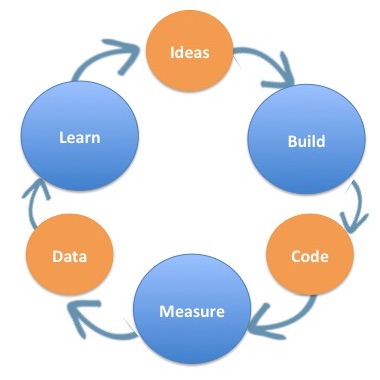
Build-->Measure-->Learn cycle graphic in blue and orange

“What would it look like if our associations acted like a startup?”

I was honored to be featured on a recent Professionals for Association Revenue podcast with my client Chrissy Bagby, Chief Strategy Officer, American Association of Veterinary State Boards.

Chrissy and I talked about the principles of lean startup and how AAVSB is using them to identify a real and significant problem for new audience and beta-test potential solutions to find the one that will work for that audience, at a price they’re willing to pay.

Check it out at https://mypar.org/podcast/aavsb-innovation-startup/.

Prefer to read about it? Check out Innovate Smarter on the PAR blog.

Want to learn more? Check out Innovate the Lean Way, a monograph I co-authored with Guillermo Ortiz de Zárate (currently Chief Executive Officer and Executive Vice President, the American Society of Appraisers, although he was at the National Council of Architectural Registration Boards at the time) in 2015.

Image credit: Steve Blank

Of Non Dues Revenue and Opportunity Costs

A black vacuum cleaner sucking up US dollar bills on a hardwood floor background

I recently had the opportunity to participate in an ASAE Marketing Mavens call focused on association career centers.

My question for the group was: Many of my clients are finding that their career centers are not performing as well as they used to. Anyone else experiencing this? Thoughts as to why this is happening? Anyone come up with any solutions?

Participants came up with lots of good ideas and suggestions:

  • Lots of folks reported similar experiences – declining use, declining revenue. Sometimes that was a result of competing with yourself, with members posting jobs directly in private online communities for free. Sometimes that was a result of outside competition from platforms like LinkedIn and Glassdoor. There are lots of opportunities for free posting that also reach much larger audiences.
  • Another issue people raised was: Is it even appropriate to classify a career center as a “member benefit” if everyone has access? On the other hand, it’s totally counter-productive to restrict access to the job listings, as then the site is no longer useful to employers who pay to list jobs.
  • One participant mentioned that the industry their association serves experiences regular pauses in hiring due to change of presidential administrations and resulting uncertainty. (This is kind of a separate issue, as other participants agreed that for their associations, declining participation and revenue are a longer-term trend.)
  • We talked about the importance of promoting your association’s career center effectively, with several participants recommending using a third party platform with a revenue share if at all possible. Career center vendors tend to have dedicated marketing teams and proven tools you can use, which an association trying to do this internally may lack.
  • Participants that were still experiencing success reported that their associations were more focused on providing a “career community,” of which the job board is only one component. They were adding services like career coaching, career advice content, on-site job fairs at conferences, and resume review.
  • Other suggestions included: giving members one free job listing a year (via a promo code), opening up the career center to internships as well as full time paid positions, offering display ads on the site for things other than just jobs, and reserving new postings for member-only access for the first 72 hours.

But (here’s a dated reference for you), the $64,000 question is: Is there still any value in doing this?

And it got me thinking about the concept of opportunity cost. Career centers have historically been good sources of non dues revenue for associations. And if your career center is still bringing in at least some revenue, and the investment of time and attention from your staff to create that revenue stream is minimal, then it’s probably worth continuing, at least for the time being.

But that’s a calculation you need to keep an eye on in ALL your programs, products, and services: What’s the benefit? What’s the cost? Not just direct dollars, but also staff time and attention that, if devoted to this, are not available for something else that might either produce more revenue or be more valuable to members or both?

Photo by rc.xyz NFT gallery on Unsplash